Seedless Crushed Chili with Defined Flake and Heat Requirements
For seedless crushed chili, choose a granule or flake grade and write its particle requirement separately from the seed-state requirement. Our seedless crushed-chili reference lists 20,000–30,000 SHU and a dried granule form. A separate Korean-style flake route offers 5–25 mesh options with seed-state choices.
We recommend starting with the more specific hot granule when that heat suits your recipe, or selecting a flake grade when your project needs a different texture and heat. The accepted sample should settle the physical form before a bulk quotation is finalized.
Begin with the Particle Visible in the Finished Food
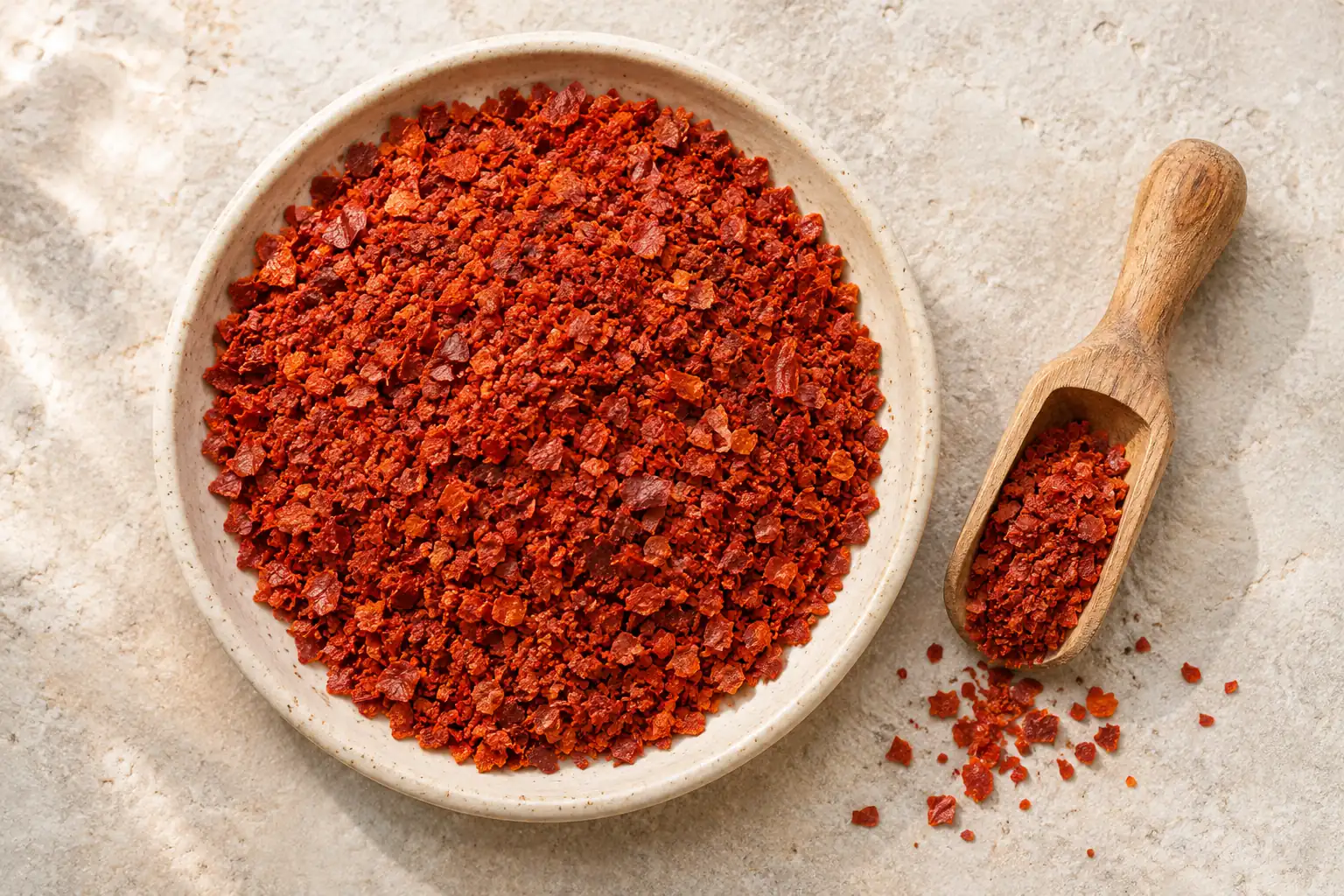
Describe what the consumer should see in your cooked sauce, filling, topping or seasoning. A coarse red flake has a different role from a fine powder even when both have a seedless description. State whether the particle should remain distinct after your mixing and cooking steps.
An appearance target is more useful when accompanied by a sample or clear physical criteria. Include the proportion of fine material and oversized pieces that would affect your finished texture, then agree how the selected grade will be assessed.
A Hot Seedless Granule as One Defined Route
The seedless crushed-chili product lists chilli as its ingredient, raw dried processing, granule shape and 20,000–30,000 SHU. Those fields establish a specific starting point for a hot culinary ingredient. The actual granule dimensions still need to be agreed.
Keep heat and cut together in your enquiry. A sample that meets the desired particle appearance may still be too hot for your food at the intended dose, so evaluate both before choosing this route for production.
| Selection field | Starting point | Confirm for purchase |
|---|---|---|
| Form | Raw dried granule | Actual size distribution |
| Seed state | Seedless description | Acceptance criteria |
| Heat | 20,000–30,000 SHU | Required sample or lot basis |
A Flake Grade Selected from the Available Options
Our Korean-style red flake reference lists flakes at 5–25 mesh, separate powder and whole-pod choices, and seed or seedless states. Specify the flake option you want and ask for its actual grade. The whole-pod or powder measurements do not describe a flake order.
The same selection needs its own heat target and processing requirement. Keep these choices explicit rather than treating a catalogue with several formats as one fixed combination. This is the route to explore when the hot granule does not match your intended food.
Define Seed State with an Acceptance Condition
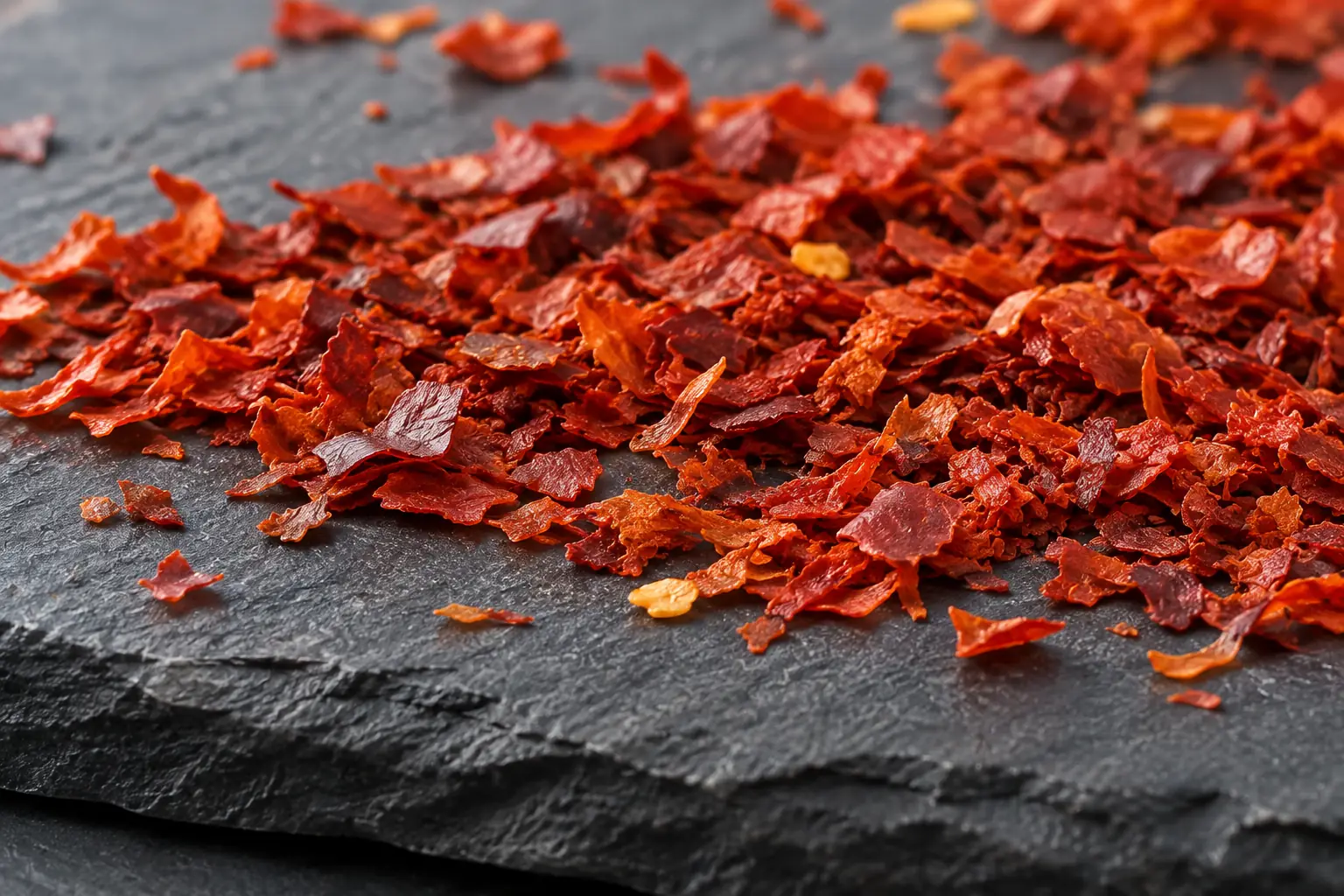
A seedless description does not provide a quantified zero-residual-seed result. State what your operation needs, including whether visible seed fragments affect appearance or texture and how the sample will be examined.
Agree a practical acceptance record for the material being purchased. Keep the observation conditions, sample identity and decision together. If your requirement includes a numerical limit, define its measurement basis with the supplier rather than inventing a percentage from a product photograph.
Keep Sieve and Visual Checks Complementary
A mesh label helps identify a candidate but does not by itself show every particle dimension. Agree the sieve standard and the passing or retained fractions needed for your process. Do not substitute a guessed millimetre conversion for the selected flake specification.
Visual assessment is still useful for irregular chili skins, especially when a few large pieces or fine dust change the food's appearance. Use both the agreed physical specification and the retained sample to communicate what your team is approving.
Test the Flake in Your Actual Preparation
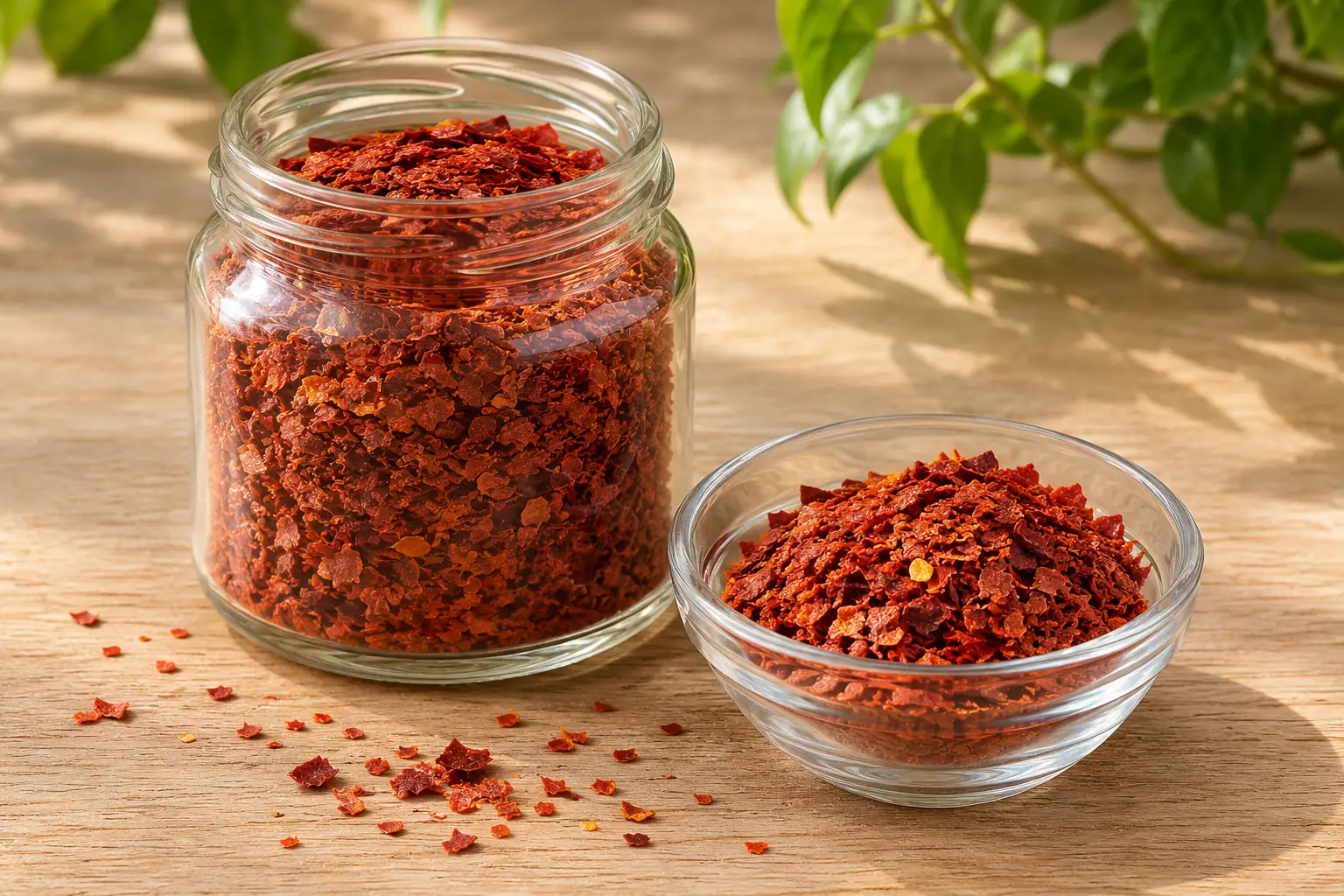
Compare the candidate in the intended food under consistent inclusion, mixing and cooking conditions. Record heat, visible red pieces and texture after processing, rather than judging the dry flake alone. A flake used for a topping may need a different appearance from one incorporated into a sauce.
If the result calls for a finer or milder grade, change that requirement explicitly and obtain the corresponding sample. Do not approve one physical sample and order a broadly named substitute without reconnecting the specification.
Treatment and Storage Follow the Selected Grade
The hot granule is listed as raw dried material with ambient cool dry storage. The multi-option flake reference includes treatment choices and a shelf-life statement tied to cold conditions. Confirm the handling and treatment instructions for the grade selected.
For a finishing application, agree the processing evidence your operation requires. Dry form and seed removal do not establish pathogen reduction. Keep the actual treatment choice and required records attached to the flake rather than extending instructions from another product.
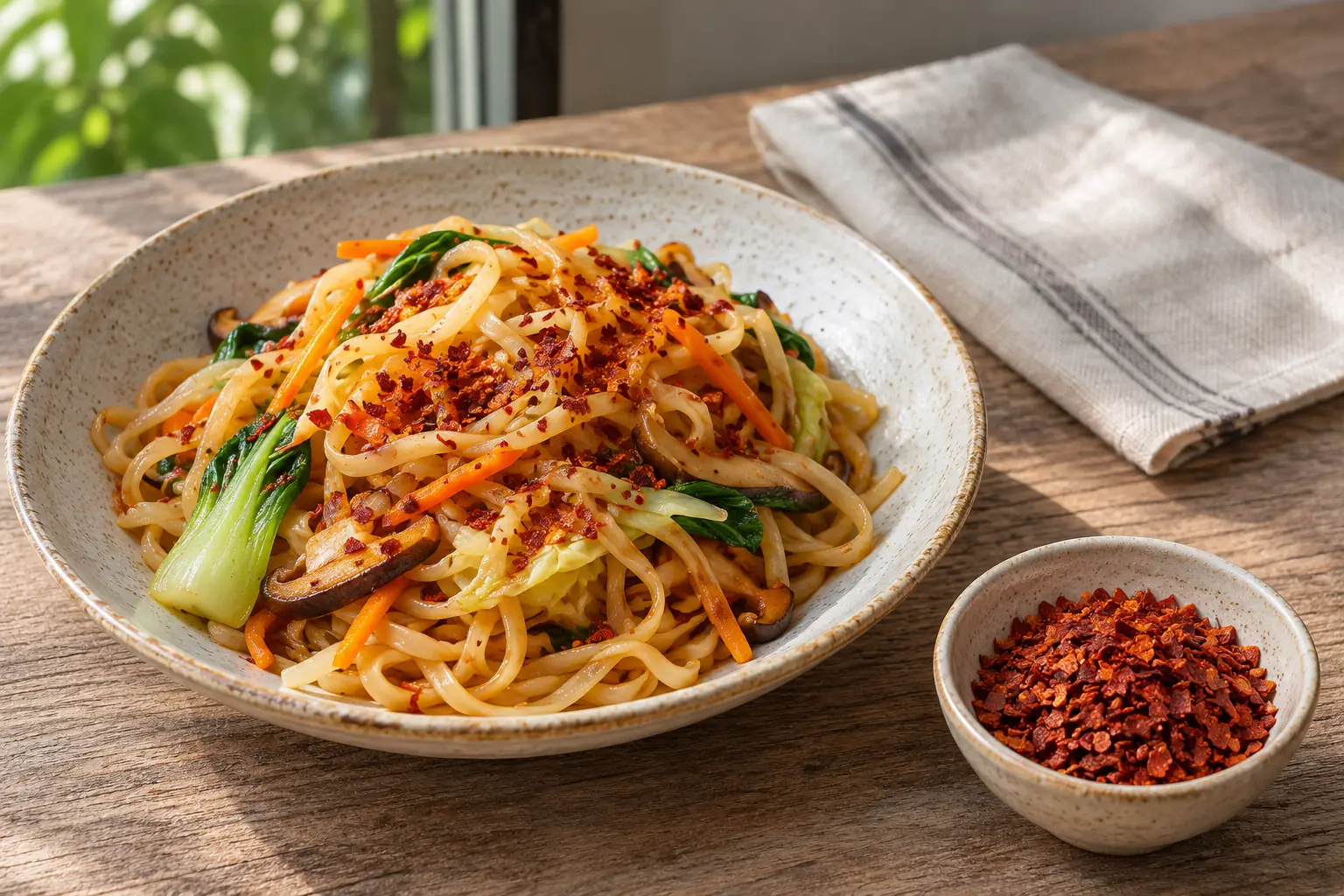
Specify One Crushed-Chili Grade for the Order
Your purchasing description should identify crushed chili, the agreed particle distribution, seed-state condition, heat target and treatment requirement. Add the packing format needed by your operation and the accepted sample reference.
We can discuss the specific hot granule or a selected flake option against that brief. This keeps the order focused on a visible food ingredient, with powder and ring cuts handled as separate choices when they better fit your product.
Discuss a Seedless Flake Specification